Margaret “Peggy” Morden (nee Parliament) – 1772-1868
Peggy was born in Orange County, New York, in 1772. Her parents were John Parliament (an anglicized version of “Juriaen Georg Parleman”, 1723-1788) and Maria Anna Garnier (1741-1793).
Reference material:
“Family of George Parliament and Jane Garnier in Upper Canada“, compiled by John A. Brebner (PDF)
The following is extracted from “History of the Settlement of Upper Canada…“, William Caniff, 1869
“Mrs. Morden, of Sophiasburgh, was born upon the banks of the Hudson, forty miles from its mouth. Her birthday stretches back ninety-eight years. She came into Canada with her father, George Parliament, who was of German parentage, born upon the sea; and like the ocean, he was through out his brief life tossed up and down with scarcely a day of calm and sunshine. The family reached the Fourth Town, and only six weeks after her father’s eyes were closed in death. Mrs. Morden has a distinct recollection of the rebellion. Her father was staunchly loyal, and she has heard him repeatedly declare that he would lay his bones in the King’s domains. During the war he was imprisoned twice, at Goshen and Poughkeepsie. She was thirteen years old when they came to Canada, and remembers the many weary days of travel by Oneida Lake. Her father walked and drove the cattle all day, her mother would sit up till late at night over the camp-kettle preparing food for the party to use the following day, so that there would be no delay on the way.”
“Having crossed from the States, the Skenectady boats landed at Little Catariqui. The father was down below on the St. Lawrence swimming the cattle across the stream. They found their flour was nearly done. She, with a little sister, went along the shore to the village of Kingston to buy flour, she had only enough money to buy a quarter of a hundred of second flour, which she carried from McAulay’s store to the hungry company at the Little Catariqui, where they were wind-bound. She remembers the appearance of the shores as they journeyed along; the rude log cabins in the small clearings. The family of eleven children settled upon the north shore of Hay Bay.”
“The eldest boy was nineteen years old. They now thought that they, in common with other settlers, would be permitted to work out a peaceful and happy future, but the arrow of death was already in the bended bow. The mournful occasion can hardly be appreciated, the father of eleven children in the wilderness suddenly cut down. Each of the neighbours had quite enough to do to care for his own family. All these terrible facts are fresh in the mind of the venerable lady. The events of later years are faded from her memory, but those are too deeply engraven upon her mind, by the pen of sorrow, to be erased while life lasts and mind sits enthroned. The subsequent events connected with the family for a time are no less distressing. They had one cow, the milk of which supplied them with their principal food. Fish was occasionally caught. But they often had to seek herbs and greens. For weeks they were in the greatest distress for the very necessaries of life. All of the family who were old enough went out to work. The following spring, and the subsequent ones, her mother made sugar, not to use in the family, “oh! no, that was too great a luxury.” It was all carried and sold for flour. Mrs. Morden remembers it, for she carried much of the sap. She subsequently worked out, until after several years she found a kind supporter. Mrs. Morden, whom the writer saw nearly four 661years ago, (1865), was then, although so old, yet vigorous and sprightly, with a kindly face, and even a sharp eye. Of all the persons it has been our privilege to converse with, there are only a few who gave such clear and appropriate testimony, and afforded so much satisfaction. She confined her remarks strictly to the questions, and we learned much in a short hour. She spoke feelingly; and with Christian nobleness said she, “I have lived a long time and had many blessings, thanks be to God.” Thus spoke the lips of one whose youth had been spent in another century.”
She married James Amit Morden on 27 December 1792 in St. John’s Church, Bath, Ernestown, Lennox County, Ontario. The Rev. John Langhorn officiated, and the witnesses were James Colter, Isaac Parliament, Phebe Crokhite, and Margaret Mordoff (records of the Rev. John Langhorn).
Together, they had ten children:
- George Morden b. c. 1796.
- James Plummer Morden b. 22 January 1798.
- Joseph James Morden b. c. 1794.
- Isaac Morden b. 1800.
- Richard James Morden b. 06 December 1801.
- Lorraine Morden b. 07 January 1804.
- John Parcels Morden b. 27 June 1806.
- Benjamin S. Morden b. c. 1808.
- Andrew Morden b. c. March 1815.
- Margaret Morden b. 22 June 1812.
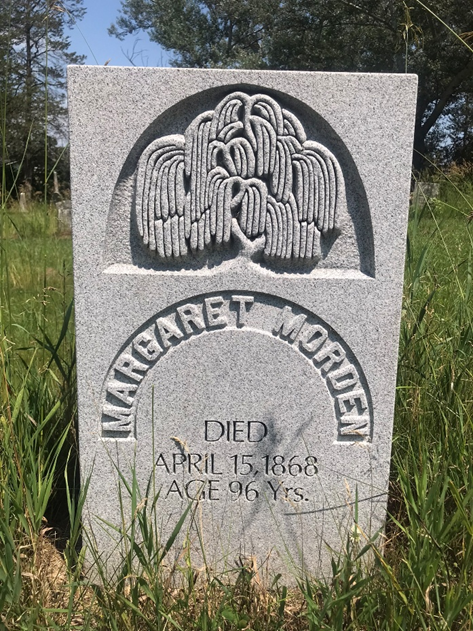
Peggy died on 15 April 1868, at Sophiasburgh. Her grave is in Prince Edward County, Ontario, at the old Lazier-Cronk Cemetery (Sophiasburgh). This photo was taken in July 2023.
Prince Edward County